
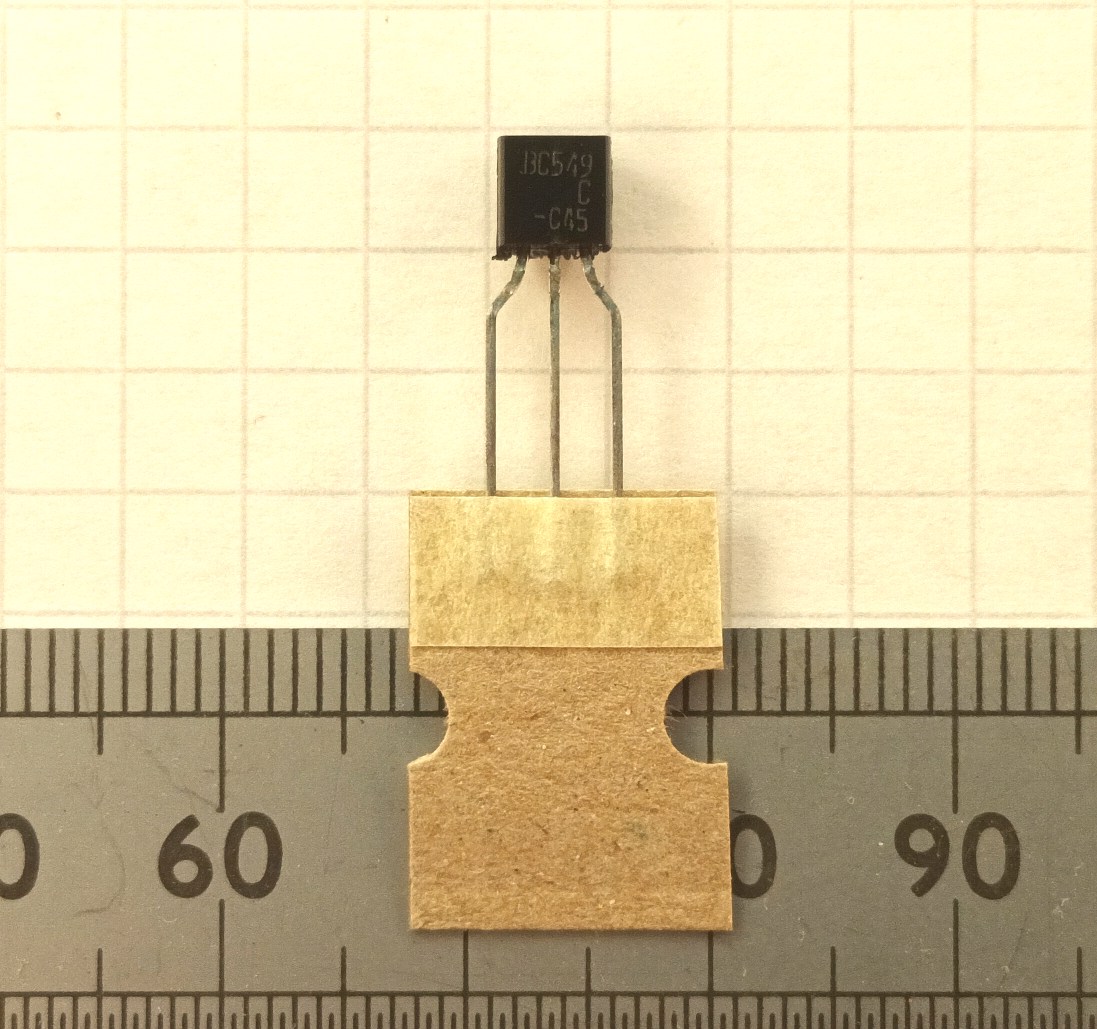
It's Q1, a BC549C.
Once upon a time, in the dim recesses of the early 1970's, in the UK and Europe, there was the BC109C NPN low noise silicon transistor. This was housed in a TO-18 metal can transistor package which is a bit expensive. Pretty quickly, clever people figured out how to passivate the exterior of the tiny silicon crystal inside the package, by turning the surface of it into silicon dioxide. Silicon dioxide is glass, so it's quite hardy and well sealed even if the plastic might let some moisture through over long periods of time. As you no longer need a great expensive metal can to protect the silicon, the BC549C was born, in a much cheaper TO-92 plastic package.
In the old attempt at a European systematic transistor naming convention, in "BC549C," the B stands for silicon, the C represents a certain power handling range, 549 is pretty-well made up by the original manufacturer within a certain product range, and the C suffix is a D.C. current gain (Hfe or Beta) banding indication. C is the highest gain banding available for a BC549. Lower gain B types are available. If you have a BC549 with no suffix, it isn't gain band selected, so it could be in either gain range. We definitely want the higher gain range type for this radio. With modern transistor manufacturing and production testing techniques, any price difference is almost non-existent. (In fact, you might even pay more for a BC549B)
In our circuit, Q1 BC549C is the workhorse, and transformer L2 is the wheel that it's pushing. Kind-of. Because regeneration through the regen coil gives the horse a bit of a radio frequency whip, and reflex action through C2 and C3 pushes up, and lets more audio oats bias current through.
If you can make-up a better
